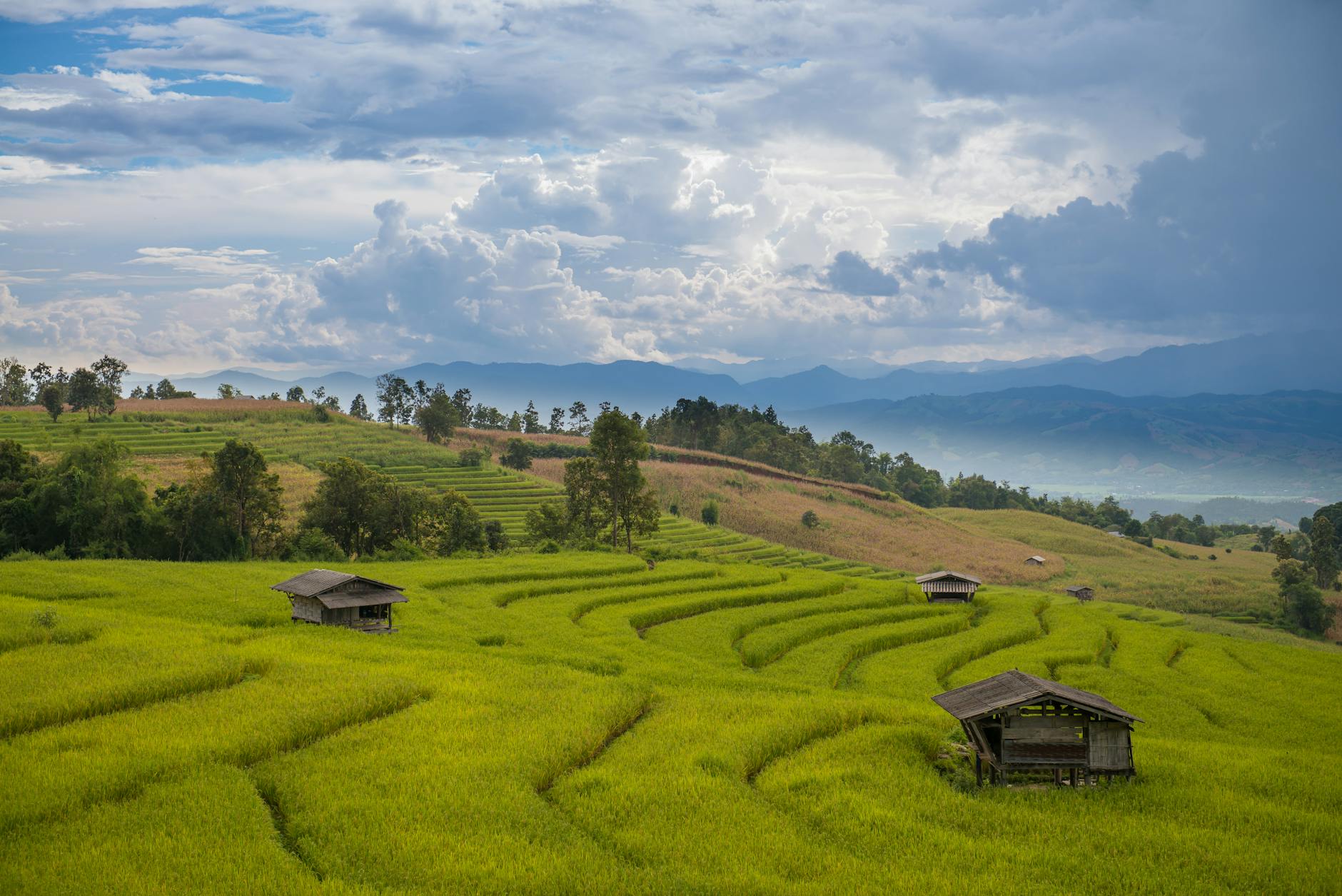
A Pgakenyaw village in a fold of Mae Chaem district where the terraces stack up the hillside. September is the green window; October turns them gold.
The terraces at Ban Pa Bong Piang are not a viewpoint you pull over for. You come around the last bend, the valley opens downward, and the entire slope is cut into steps that hold water like a stack of mirrors — hand-built, still farmed, still fed by the same gravity-run channels the village has used for generations.
The timing is the whole story
This is a working rice valley, so the view depends entirely on the crop cycle rather than on the weather forecast.
Planting happens in the wet months, and by late August into September the young rice has covered every terrace in flat, saturated green. Through October the fields turn gold as the grain ripens, which is the more famous look and the busier season. After the harvest, the terraces are stubble and mud, and there is not much to photograph.
If you want the green, September is the window. If you want the gold, plan for late October, book a homestay early, and expect company.
Shooting it
Light comes into the valley late and leaves early, because the ridges are high on both sides. Early morning is the best time by a wide margin: mist sits in the folds below the village and burns off within an hour or two of sunrise.
Shoot from the road above the village for the classic stacked-terrace compression, then walk down onto the field paths for foreground — a farmer working, a hut, a single tree on a terrace edge. Stay on the bunds between plots. They are property and they are the irrigation system.
Ask before photographing people. Ban Pa Bong Piang is a Pgakenyaw (Karen) village, not a set.
Getting there
The village sits in Mae Chaem district, on the far side of the Doi Inthanon massif from Chiang Mai city. The usual approach is to drive over Doi Inthanon and down into Mae Chaem, then follow the local road toward the village.
The last stretch is steep, narrow and unpaved in places. In the wet season it is genuinely rough — a high-clearance vehicle or a pickup is the sensible choice, and a small car after heavy rain is not. Motorbikes make it in the dry months; in September only ride it if you are comfortable on wet dirt with a drop on one side.
Without your own vehicle, the practical option is a driver hired in Chiang Mai for a full day or an overnight, or a Mae Chaem-bound songthaew followed by a local ride.
Staying the night
Several homestays sit along the ridge above the terraces. Rooms are simple — mattress, blanket, shared bathroom, tin roof — and the reason to book one is not comfort. It is being on the ridge at 6am when the mist is still in the valley and everyone who drove up from Chiang Mai that morning is still two hours away.
Bring warm layers even in the rainy season; the valley cools fast after dark. Bring cash, because card payment is not reliable up here, and bring a light for walking between buildings at night.
Before you drive up
Check the road condition and whether the terraces have been harvested — a phone call to your homestay answers both, and saves a five-hour round trip to look at mud.


